
Introduction
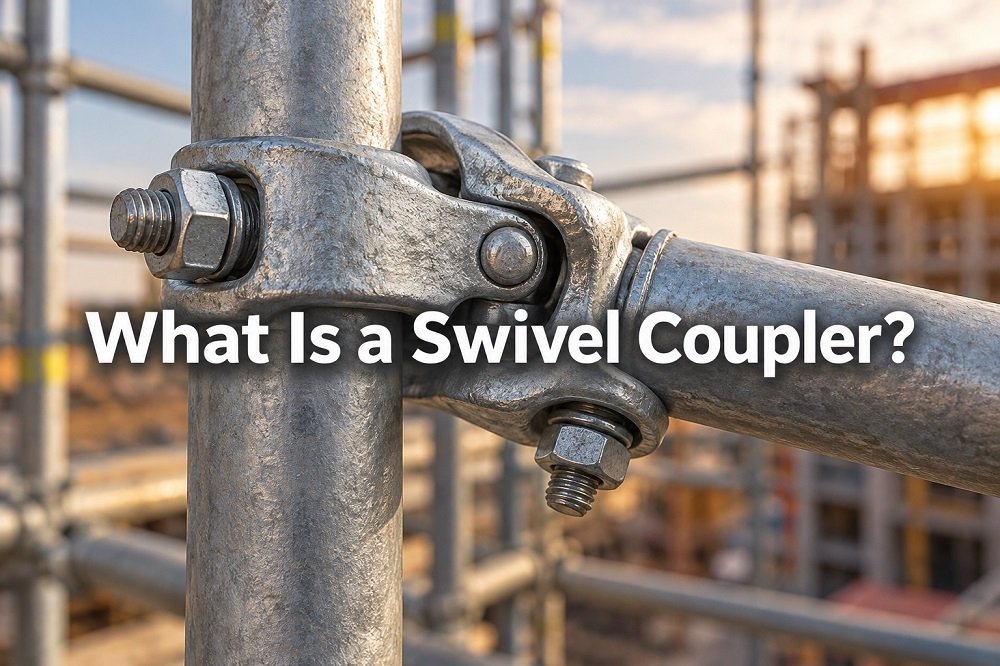
A swivel coupler is one of the most common fittings used in tube and coupler scaffolding. Its main purpose is simple: connecting two scaffold tubes where a fixed 90-degree connection is not suitable.
This makes swivel couplers particularly important for diagonal bracing, irregular scaffold layouts, temporary structures and other situations where tubes need to meet at different angles.
What Is a Swivel Coupler?
A swivel coupler, sometimes called a swivel clamp, connects two scaffold tubes while allowing the angle between them to be adjusted before the connection is tightened.
Unlike a right-angle coupler, which is designed to hold two tubes at approximately 90 degrees, the two halves of a swivel coupler can rotate relative to one another.
Once the tubes are positioned correctly, the bolts are tightened to secure the connection.
This adjustable design makes the swivel coupler useful where the scaffold geometry cannot be created entirely with right-angle connections.
Typical applications include:
- Diagonal bracing
- Facade scaffolding
- Tube and coupler scaffolding
- Irregular building geometry
- Temporary support arrangements
- Industrial access scaffolds
- Structures built around obstacles
The important point is that a swivel coupler is not simply an alternative to a double or right-angle coupler. Each type of coupler has a different function within the scaffold.
Swivel Coupler vs Right-Angle Coupler
These two couplers are often used together but perform different jobs.
| Coupler Type | Connection | Typical Application |
| Swivel Coupler | Adjustable angle | Diagonal bracing and irregular connections |
| Right-Angle Coupler | 90° connection | Connecting ledgers, standards and other perpendicular tubes |
| Sleeve Coupler | End-to-end connection | Extending scaffold tubes |
| Putlog Coupler | Single-tube connection | Connecting putlogs or transoms in appropriate scaffold configurations |
A right-angle coupler helps create the regular geometry of a tube and fitting scaffold.
A swivel coupler provides the flexibility needed when a diagonal or non-perpendicular tube must be connected.
One should therefore not automatically be substituted for the other simply because both fit the same scaffold tube.
Why Are Swivel Couplers Commonly Used for Diagonal Bracing?
Bracing helps a scaffold resist movement and maintain its intended geometry.
Because a diagonal brace normally crosses standards, ledgers or other scaffold tubes at an angle, a fixed 90-degree coupler is often unsuitable.
A swivel coupler allows the brace to follow the required diagonal line and then be secured to the scaffold tube.
This is one of its most important applications.
The adjustable connection also becomes useful where scaffold geometry changes around:
- Corners
- Sloping surfaces
- Industrial equipment
- Pipes and vessels
- Projections on a building
- Restricted access areas
However, the presence of a swivel coupler does not by itself make a scaffold stable. Bracing arrangement, scaffold dimensions, loading, ties, foundations and overall scaffold design still have to be considered together.
What Is a Forged Swivel Coupler?
Many scaffolding swivel couplers are manufactured from steel using a forging process.
During forging, heated steel is shaped under pressure using dies. After forming, the coupler body goes through additional operations such as trimming, machining, assembly and surface treatment.
A typical drop forged swivel coupler may include:
- Two forged coupler bodies
- Centre swivel connection
- T-bolts or eye bolts
- Nuts
- Washers
- Rivets or connecting pins
- Zinc or galvanized surface protection
Forging can produce strong and durable components suitable for repeated construction use.
However, buyers should be careful with statements such as:
“Forged couplers are always stronger than pressed couplers.”
Manufacturing method alone does not prove the performance of a coupler.
Material, geometry, bolt design, production consistency, heat treatment where applicable and testing all affect the final performance.
For a safety-related scaffold component, verified test performance is more useful than simply seeing the word “forged” in a product description.
Main Benefits of Swivel Couplers
Flexible Tube Connections
The most obvious advantage is adjustability.
Scaffold tubes can be positioned according to the required brace or structural geometry rather than being limited to a fixed right angle.
This is especially useful for complex scaffolds and structures with irregular shapes.
Suitable for Diagonal Bracing
Swivel couplers make it possible to securely connect diagonal tubes to the main scaffold structure.
This allows scaffold designers and erectors to create the bracing arrangements required for a particular configuration.
Reusable Construction
Quality scaffold couplers are designed for repeated assembly and dismantling.
For contractors and scaffold rental companies, reusability is important because couplers may move through many projects during their service life.
The condition of the coupler therefore matters just as much after several projects as it does when first purchased.
Adaptability on Site
Tube and coupler scaffolding is often selected because it can adapt to locations where standard modular bays alone are difficult to use.
Swivel couplers support this flexibility by allowing tubes to follow site-specific geometry.
Where Are Swivel Couplers Used?
Construction Scaffolding
They are widely used in traditional tube and fitting scaffolds, particularly for diagonal braces.
Industrial Scaffolding
Factories, refineries, power plants and process facilities often contain pipes, tanks and equipment that make access geometry complicated.
Tube and coupler components can be used to adapt scaffold structures around these obstacles.
Building Maintenance and Renovation
Existing buildings do not always provide simple or regular scaffold layouts.
Swivel couplers make angled connections possible when scaffolds need to follow unusual elevations or building features.
Temporary Structures
The same connection principle can also be useful in certain temporary access, support and staging arrangements where scaffold tubes are used.
The actual scaffold configuration should always follow the applicable design and site requirements.
Which Standard Applies to Swivel Couplers?
For European and UK applications, EN 74-1 is an important standard for common scaffolding couplers.
The current British adoption is BS EN 74-1:2022+A1:2025 – Couplers, spigot pins and baseplates for use in falsework and scaffolds – Couplers for tubes: Requirements and test procedures.
The standard covers friction-type:
- Right-angle couplers
- Swivel couplers
- Sleeve couplers
- Parallel couplers
It addresses areas including materials, design requirements, strength classes, resistance and stiffness, testing, assessment and production control.
This distinction is worth noting because the term “BS 1139 coupler” is still widely used commercially.
BS 1139 remains relevant to scaffolding, but it should not simply be treated as an interchangeable name for every steel scaffold coupler. BSI states that steel right-angle, swivel, sleeve and parallel couplers are covered by BS EN 74-1, while BS 1139-2.2 covers specified couplers and fittings outside that scope.
For international buyers, the required standard should therefore be confirmed according to the target market, project specification and intended scaffold system.
How Much Load Can a Swivel Coupler Carry?
This is one area where buyers should be cautious.
It is common to see websites state one universal load capacity for all swivel couplers. In practice, this can be misleading.
The relevant performance depends on factors such as:
- Coupler design
- Coupler classification
- Scaffold tube specification
- Tightening torque
- Slip resistance
- Material and production quality
- Applicable test method
- Direction of loading
- Condition of the coupler
EN 74-1 itself defines strength classes and structural parameters rather than treating every coupler of the same general name as having identical performance.
For procurement, therefore, a better question than:
“What is the load capacity of a swivel coupler?”
is:
“What tested performance does this specific coupler achieve under the applicable standard?”
The supplier should be able to provide the relevant product specifications and, where required, supporting test documentation.
What Should Buyers Check Before Ordering Swivel Couplers?
Price is only one part of the purchasing decision.
1. Applicable Standard
Confirm which standard or project specification the coupler needs to meet.
For European or UK projects, this may include EN 74 requirements.
2. Scaffold Tube Compatibility
Check that the coupler is suitable for the scaffold tube dimensions used in the target market or scaffold system.
Do not assume every coupler fits every tube specification.
3. Manufacturing Method
Confirm whether the required product is forged, pressed or another specified design.
If forged couplers are required, ask what parts are forged rather than relying only on the product name.
4. Bolt and Nut Configuration
Bolts, nuts and washers receive repeated tightening during the working life of the coupler.
Their dimensions, threads and consistency therefore affect practical installation and maintenance.
5. Surface Finish
Common options may include electro-galvanizing and hot-dip galvanizing, depending on the product specification.
The appropriate finish depends on expected exposure, customer requirements and target market.
6. Testing and Documentation
For projects requiring compliance evidence, confirm what documentation is available before ordering.
Depending on the requirement, this could include product specifications, test reports, material information or production inspection records.
7. Batch Consistency
A sample may perform well, but commercial orders often involve thousands of couplers.
Buyers should therefore consider whether dimensions, bolts, surface finish and functional movement remain consistent across production batches.
How Should Swivel Couplers Be Inspected?
Reusable scaffold equipment should be inspected as part of normal scaffold control procedures.
For swivel couplers, common inspection points include:
- Cracks or visible damage
- Excessive deformation
- Severe corrosion
- Worn threads
- Damaged nuts or bolts
- Missing components
- Abnormal movement at the swivel joint
- Contamination that prevents correct tightening
- Difficulty opening or closing the coupler
- Evidence of previous overloading or misuse
A damaged coupler should not simply be forced back into service because it can still be tightened around a tube.
The condition of the complete connection matters.
Forged Does Not Replace Testing
A forged swivel coupler can provide a durable solution for demanding scaffold applications, but manufacturing terminology should never replace performance verification.
For buyers, the better approach is to evaluate the complete product:
Material + design + manufacturing + finish + testing + quality control.
That provides far more information than simply comparing whether two quotations both contain the words “drop forged swivel coupler.”
Conclusion
Swivel couplers are relatively small scaffold components, but they perform an important function.
By allowing scaffold tubes to be connected at adjustable angles, they make diagonal bracing and irregular scaffold configurations possible.
For contractors, distributors and scaffold rental companies, choosing a swivel coupler should therefore involve more than comparing unit prices. Tube compatibility, manufacturing quality, applicable standards, surface treatment, testing and batch consistency should all be considered.
The right coupler is not simply the one that fits the tube. It is the one that fits the application, scaffold design and project requirements.